
Emily Jashinsky asked for proof. The AHA Foundation’s 990 filings provide it.
By Ayesha de Queiroz
Last week a journalist named Emily Jashinsky amplified Ayaan Hirsi Ali’s Free Press piece on the SPLC indictment, framing Hirsi Ali as an anti-extremist dissident the SPLC had endangered. I replied that I was writing a response to her piece, that it wasn’t smart to promote her and that she was a liar. Jashinsky’s counter was a challenge: she doesn’t play guilt by association unless there’s evidence someone changed their views for cash, and if I wanted to call Hirsi Ali an extremist, I needed to prove the content of her arguments, not the company she keeps.
Those are fair standards. I intend to meet both of them. But first, something about how networks work.
Jashinsky told me she had never heard of Nina Rosenwald, whose philanthropy funds Islamophobic and pro-Israel organizations including the Independent Women’s Forum, where Jashinsky is a senior fellow. Rosenwald also funded the AHA Foundation, where Christina Hoff Sommers sat on the board from 2009 to 2015. Jashinsky began her career as Sommers’s intern at AEI. I believe her when she says she doesn’t know the architecture. Networks don’t require members to know the full architecture. They require only that members share the framings the architecture produces, and defend colleagues when those framings are challenged. That’s what happened in our exchange. It happens thousands of times a day across platforms and publications, without coordination, through shared instinct. The network protects its players not through conspiracy but through reflex loyalty.
Emily Jashinsky also addressed the SPLC indictment in a corresponding episode of her YouTube channel, After Party With Emily Jashinsky, and in a piece published in UnHerd, where she states she has been investigating the Southern Poverty Law Center’s failures since 2017. Nine years of investigative reporting produced a treatment of Ayaan Hirsi Ali that amounts to a single sentence, ‘one of the world’s preeminent opponents of hatred and extremism’, indistinguishable from her boilerplate biography entries that appears on any one of the think tank websites that fund her network. Which, on reflection, makes her claim to have never heard of Nina Rosenwald entirely believable.
Ayaan Hirsi Ali is very good at producing that reflex.
The murder of Hirsi Ali’s film collaborator Theo van Gogh was a violent traumatic event that cannot be denied. The letter pinned to his chest was addressed to her. So was his publicly documented record of racist and antisemitic statements, a history absent from her account and from the Counter Extremism Project source she cites, which describes him only as “a prominent critic of Islamic fundamentalism.” That erasure matters, not as justification for what happened to him, but because it is the first move in a martyrology that depends on simplified victims. She has been constructing that martyrology ever since. Her own first person account of opposition to Islam is attached to and amplified by personalities and institutions that exploit her crafted narrative in support of bigotry and hatred throughout her career as an anti-Islamic campaigner.
The threat to her life, documented in 2004, has become the permanent credential that places her beyond scrutiny. Masih Alinejad operates the same way, another woman exiled with claimed assassination attempts, formally received by the Secretary of State, in another network made untouchable by a story that cannot be questioned without appearing monstrous. The comparison is instructive because it reveals the mechanism. There are other anti-FGM activists and other former Muslim women who have written and spoken publicly about the harms of Islamic fundamentalism at genuine personal cost, without armed escorts or Hudson Institute fellowships or Nina Rosenwald’s philanthropy. They do not attract the same scale of threat, or the same scale of institutional support. The difference is not the message. The difference is who the message serves, who funds its delivery, and which foreign policy objectives its repetition at global scale helps to justify. The threat narrative, whatever its relationship to her current reality, functions to make that question unanswerable. You cannot interrogate the instrument without appearing to endorse the violence against it. That is the asset’s most valuable feature in a dependent servile relationship.
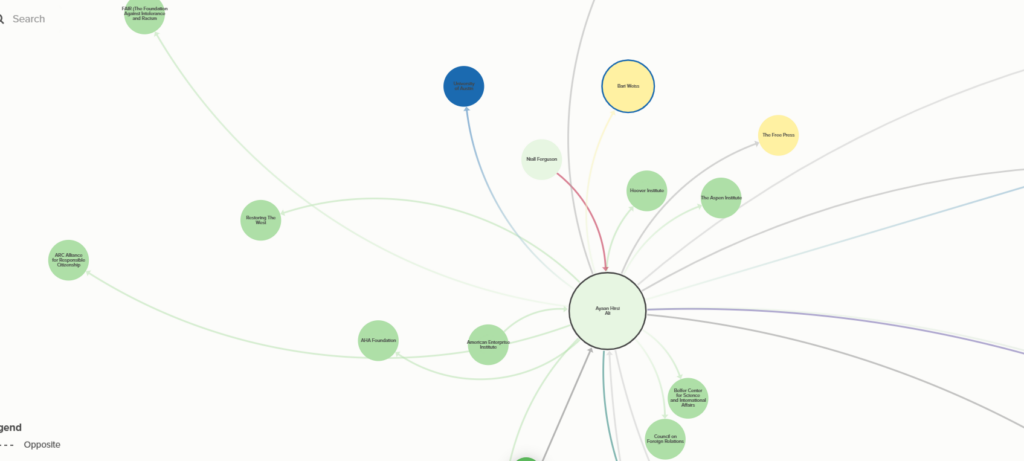
Network map: The institutional infrastructure around Ayaan Hirsi Ali. Click to explore the full interactive map.
The prosecution she doesn’t name
The Free Press piece opens with the SPLC indictment as if it arrived from neutral skies. The wire fraud, bank fraud, conspiracy to commit money laundering, allegations that the SPLC funneled money to informants embedded in white supremacist groups. Hirsi Ali presents this as justice finally catching up with an organization that wronged her, but the documented evidence against her network exists independently of the SPLC and whatever the indictment proves or doesn’t prove.
She does not mention, once, who brought the prosecution.
The indictment was announced by Acting Attorney General Todd Blanche and FBI Director Kash Patel, both Trump appointees. An administration that has so far engaged almost exclusively in partisan lawfare at the behest of donors or serve Trump personally. The Biden administration investigated these same allegations and declined to prosecute. Blanche himself confirmed this: “I don’t have any insight into why the decision was made to not pursue the investigation, and we started it again.” Democrats on the Senate Judiciary Committee, including Schumer and Schiff, called it a politically motivated attack on civil rights infrastructure. Hirsi Ali presents a prosecution that a previous administration’s lawyers decided lacked merit, reopened by Kash Patel, as self-evident justice.
She is using a Trump DOJ prosecution to rehabilitate herself. That tells you whose interests she serves.
The settlement she misrepresents
She also misrepresents what the SPLC’s 2018 settlement with Maajid Nawaz actually established. The SPLC’s statement was specific: Nawaz and his organization Quilliam were “most certainly not anti-Muslim extremists.” That finding applied to one person whose case was genuinely distinguishable, a former Islamist who had turned to countering extremism from within Muslim communities. It was not a blanket exoneration of all fifteen people on the list. The settlement says nothing about Hirsi Ali. It says nothing about David Horowitz or Daniel Pipes, whom she names as fellow victims in her piece. Pipes is a co-founder of her current nonprofit, CLARITy, an anti-Islamic advocacy coalition. Both are confirmed recipients of funding from the same donor network her own organization operates within. She presents a targeted apology to one person as vindication of an entire roster.
The sources she chose
A rehabilitation argument is only as credible as its sources. Hirsi Ali’s source list deserves examination.
She cites splcexposed.com, a website whose entire purpose is attacking SPLC, not a journalistic outlet. She cites the Washington Times, founded by Sun Myung Moon’s Unification Church and consistently aligned with the hard right. She cites Newsbusters, a Media Research Center publication that exists specifically to attack liberal media organizations. She cites a Republican House Oversight Committee opposition research letter whose footnotes run almost entirely to Fox News, ADF’s own website, and the Washington Free Beacon. She cites Fox News. She cites Hudson Institute to vindicate herself from extremism charges, without disclosing that she is employed by Hudson Institute, that Hudson hosted the CLARITy Coalition’s 2024 conference, and that Hudson’s institutional network overlaps with the same donor infrastructure her critics have documented.
The only independent outlets she uses are Ken Silverstein’s Harper’s investigation and Bob Moser’s New Yorker piece, legitimate left-liberal criticisms of SPLC’s financial practices and institutional culture. Those criticisms are genuine. But they are categorically different from a criminal conspiracy to fund white supremacists, and she collapses that distinction deliberately, using decades of credible journalism about SPLC’s fundraising problems to launder a Trump DOJ prosecution the previous administration declined to pursue.
The methodology she calls criminal
The indictment’s core allegation, that SPLC paid informants embedded in white supremacist groups, describes standard counter-extremism methodology. The FBI has used paid informants inside extremist organizations for decades. Legal experts quoted in coverage of the indictment explicitly note that infiltrating extremist groups is “common practice for police and the FBI.” SPLC’s interim CEO states the informants “risked their lives to infiltrate and inform on the activities of our nation’s most radical and violent extremist groups” and that the intelligence “saved lives.”
Nina Rosenwald, whose philanthropy built the donor infrastructure Hirsi Ali’s network draws from, is documented in Project Veritas’s own tax filings as an early financial supporter of James O’Keefe’s covert operative organization, confirmed by a 2017 Daily Beast investigation. Robert Shillman, another major funder in this ecosystem whose philanthropy supports the David Horowitz Freedom Center, funded Shillman Fellowships through Rebel Media for Laura Loomer, Raheem Kassam, and Katie Hopkins, and helped pay Tommy Robinson’s salary, confirmed by the Times in 2018. Shillman also funded Brigitte Gabriel’s ACT for America, Rebel News, and provided nearly $214,000 toward Geert Wilders’ legal defense against hate speech charges, confirmed by Dutch investigative outlet Follow the Money. These operations, running paid operatives and producing content designed to infiltrate and influence public discourse, drew no indictments nor does Hirsi Ali reference them in comparison. The selective application of the “private organizations can’t do this” legal argument, applied to SPLC but never to the network that embedded operatives in Muslim communities, mosques, and civil society groups across two decades, is not principled law enforcement. It is political targeting with a documented timeline: FBI severed ties with SPLC in October 2024 under Patel, Republicans held hearings in December labeling them “partisan and profitable,” indictment followed in April 2026.
The organizations she defends
Hirsi Ali argues that the SPLC’s Hate Map wrongly targeted mainstream conservative organizations. She names the Family Research Council, Alliance Defending Freedom, Moms for Liberty, and the Center for Immigration Studies.
The Family Research Council has lobbied against hate crime protections for LGBTQ people and supported legislation criminalizing homosexuality abroad. Hirsi Ali claims SPLC never acknowledged that their map inspired Floyd Lee Corkins’s 2012 attack on FRC headquarters. SPLC’s own press release from the day after the shooting directly contradicts that claim.
Alliance Defending Freedom has defended laws imposing the death penalty for gay sex in other jurisdictions, and collaborated in Romania with groups whose leader ran white nationalist radio stations affiliated with David Duke and wrote for a neo-Nazi publication. ADF is one of the central legal organizations driving the current federal attack on LGBTQ rights.
The Center for Immigration Studies was founded by John Tanton, a white nationalist who wrote explicitly that “for European-American society and culture to persist requires a European-American majority.” CIS circulated over 1,700 articles from VDARE, a white nationalist website, along with pieces by Holocaust deniers, antisemites, and contributors whose work appeared in Anders Breivik’s manifesto.
Moms for Liberty presents a more complicated case than FRC, ADF, or CIS, and that complexity deserves acknowledgment. Advocating for parental access to school records, curriculum transparency, and consent over medical procedures is not hate. Parents who campaigned for the privacy, safety, and dignity of school-age girls in single-sex bathrooms, locker rooms, and sports were raising concerns that many women across the political spectrum share, including those who hold no animus toward trans identified people. The model Parents’ Bill of Rights MFL promotes contains provisions that many parents would find reasonable on their face. The SPLC designation is contestable on those grounds and Hirsi Ali is not wrong to contest it.
What she doesn’t mention is that Asra Nomani, her co-founder of the CLARITy Coalition documented in AHA Foundation 990 filings, and her co-witness before Congress on Islamic extremism, was operating in the same parents’ rights space as MFL while publicly defending it on Fox News. Nomani’s record is not that of a neutral education activist. Georgetown University’s Bridge Initiative documents her advocacy for racial and religious profiling of Muslims at airports, her support for NYPD surveillance of Muslim communities, and her claim that the ordinary Arabic phrase insha’Allah constitutes a “red flag” for extremism. That MFL attracted Proud Boys to early protests and Nomani to school board meetings didn’t help its reputation, but neither defined what the organization actually was. The network’s presence inside a legitimate parental concern is a different problem than the organization itself being hateful, and it’s a more damaging one, because it means the concerns of real parents became cover for an agenda most of them didn’t sign up for. That is the network Hirsi Ali’s piece does not disclose when presenting MFL as a victim of SPLC overreach.
She presents these organizations as victims of SPLC overreach alongside herself.
The cash
Emily Jashinsky asked for evidence of changed views for cash. The AHA Foundation’s IRS 990 filings, a public record, provide a precise answer.
Through 2021, the AHA Foundation’s mission statement read: “WE BELIEVE IN LIBERTY FOR ALL.” By 2022, four years into documented Rosenwald foundation funding, that mission had been replaced in the organization’s own federal filing with “COMMITTED TO PRESERVING, PROTECTING, AND PROMOTING WESTERN FREEDOMS AND IDEALS.” The word liberty, universal, unqualified had become Western. That is not a subtle editorial adjustment. That is a mission replacement, documented in a federal filing, tracking the ideological shift of the donor infrastructure funding the organization.



The 2024 filing goes further. Program 4b is titled, in the organization’s own words, “ACTIVATE CONFRONTING ANTI-SEMITISM AND ILLIBERALISM FOLLOWING THE EVENTS OF OCTOBER 7, 2023.” The program description states that “AHA FOUNDATION EXPANDED ITS PROGRAMMATIC FOCUS TO ADDRESS THE RISING THREAT OF ANTISEMITISM AND THE ALLIANCE BETWEEN ISLAMISM AND FAR-LEFT IDEOLOGIES.” This is not a response to new evidence about Islam. This is a documented programmatic pivot, timed to October 7, using language that serves the political interests of the donor network funding the organization. The 2024 filing documents CLARITy Coalition programming at $283,148, explicitly focused on what the foundation calls ‘Islamist anti-semitism and foreign influence in U.S. education’ — a programmatic expansion the filing dates directly to the events of October 7, 2023.
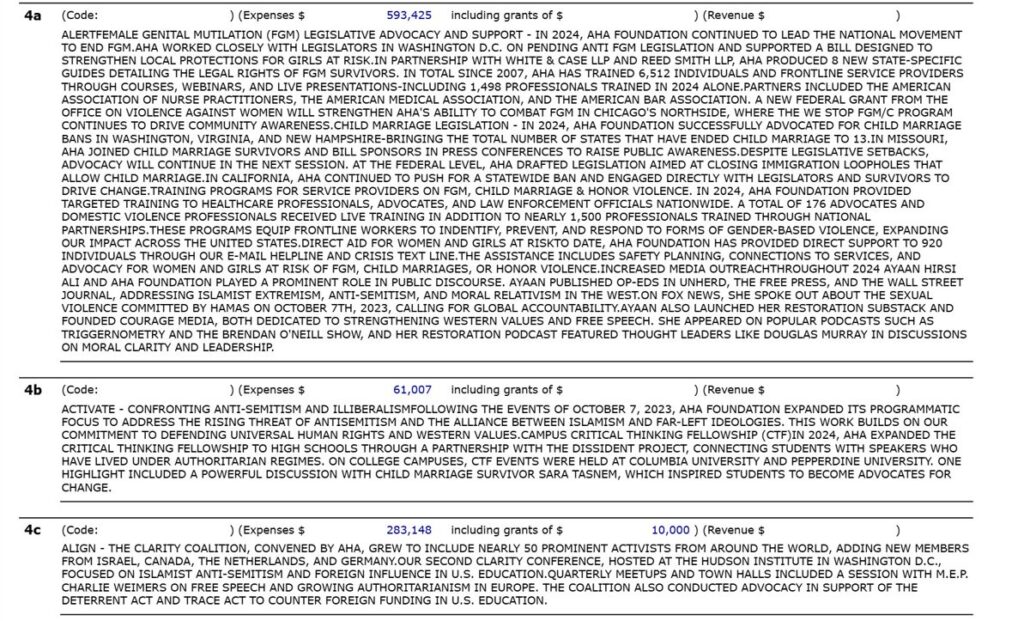
The mass rape narrative Hirsi Ali amplified following October 7, the narrative her expanded programming promotes, is contradicted by UN forensic investigators. The prosecutor assigned to investigate sexual violence committed on October 7 stated on record that no complainants had come forward. Ramy Davidian, whose testimony was cited as foundational to the narrative, recanted key claims. While Hirsi Ali’s foundation expanded its programming around the October 7 sexual violence narrative, the UN Commission of Inquiry’s March 2025 report documented the systematic use of sexual, reproductive and other forms of gender-based violence by Israel against Palestinians since October 7, concluding in paragraph 223 that this violence is used as a method of war to destabilize, dominate, oppress and destroy the Palestinian people. The narrative her donors paid to amplify does not survive contact with the primary sources. The one they paid to suppress is in a UN report.
Hirsi Ali accuses the SPLC of taking money from donors while producing content that serves their interests. After Charlottesville in 2017, SPLC’s donor surge came from Apple, JPMorgan, the Clooney Foundation, and Fortune 100 corporations responding to white supremacist violence. That same corporate giving wave directed $3.3 billion toward civil rights organizations after George Floyd’s death toward the NAACP, National Urban League, HBCUs, and affordable housing initiatives. Not one dollar went to Clarion, AHA Foundation, MEF, or Gatestone. Corporate America responded to white supremacist violence by funding civil rights organizations, not Islamophobia networks. Hirsi Ali calls SPLC’s donor base corrupt. Her own network’s donor base is documented in 990 filings, funds Tommy Robinson’s salary, and expanded its programmatic focus after October 7 to confront antisemitism in the organization’s own words.
Hirsi Ali’s article is an argument about institutional donor capture. Her own 990 filings document it happening to her organization, the mission was rewritten and the programming pivoted. The October 7 false narrative was amplified, all tracking the interests of the donor infrastructure funding her work. The indictment she is celebrating charges the SPLC with a mechanism she has not noticed operating inside her own foundation.
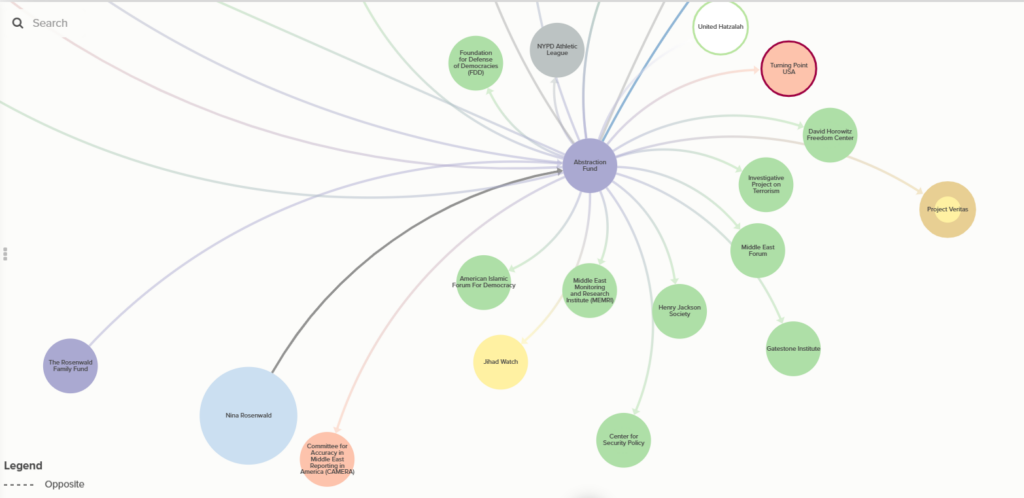
Nina Rosenwald and the Abstraction Fund: the donor infrastructure documented in IRS 990-PF filings and the Center for American Progress Fear Inc. report, the same Islamophobia network that extends through Hirsi Ali’s AHA Foundation to Tommy Robinson’s salary in Britain. Click to explore the full interactive map.
The content
On July 22, 2011, Anders Behring Breivik murdered 77 people in Norway. His manifesto cited Hirsi Ali’s arguments about Islam as a civilizational threat to the West as among his inspirations. Those arguments appear in the Free Press piece published last week, largely unchanged: the framing of Islam as an existential threat to Western civilization, the claim that institutions monitoring that threat have been captured and subverted, the rehabilitation of organizations that network’s critics have documented. A post promoting the piece drew 13 million views. That is not guilt by association. That is the content Emily Jashinsky asked me to address.|
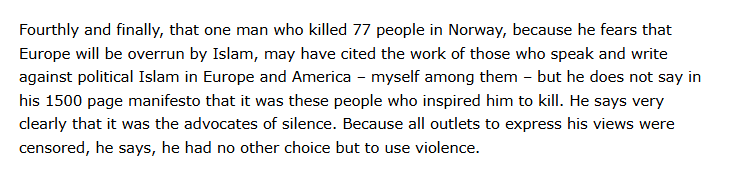
Ayaan Hirsi Ali accepts the Axel Springer Prize, Berlin, May 2012. One year after Anders Breivik cited her work in his manifesto, she acknowledged the citation from this stage while attributing his violence to those who had “silenced” debate about Islam.
The mirror she won’t look into
To explain SPLC’s institutional decay, Hirsi Ali reaches for Yuri Bezmenov, a KGB defector who described Soviet ideological subversion in four stages: demoralization, destabilization, crisis, normalization. In her reading, SPLC was not corrupted by greed or cowardice. It was subverted from within by people enforcing multiculturalist orthodoxy, its founding mission inverted to serve ideological ends.
The Bezmenov framework describes with precision what the network she works for has been doing for thirty years. Identify societal tensions. Amplify them. Infiltrate institutions. Co-opt cultural elites. Manufacture moral panics to generate donations. Normalize a new ideological order through front organizations that appear independent while serving a coordinated strategic agenda. Clarion. AHA Foundation. MEF. Gatestone. The Rosenwald network’s institutional infrastructure matches Bezmenov’s description of KGB active measures more closely than anything documented about the SPLC.
She also cites the Bataclan attack to establish that the threat was genuine and that critics of Islamism like herself were endangered by the SPLC list. The source she uses for the Bataclan is an interview with photographer Marion Ranesi, who was present during the attack. At 2:47 in that interview, Ranesi recounts that the terrorists explained to the hostages why they were there, citing French military intervention in Iraq and Syria as their motivation. The attackers’ own stated motivation is in Hirsi Ali’s own source. She doesn’t mention it. The network she works for spent decades cultivating the civilizational threat framework that made Western military intervention in Muslim-majority countries politically viable, which produced the blowback that produced those attacks. She cites the attacks. She erases the causal chain.
Repeating the same patterns
Hirsi Ali objects to being placed on an extremist lists, but doesn’t shy away from surrounding herself with extremists. On camera she tells a different story. In the same period she published her Free Press rehabilitation piece, she embraced Tommy Robinson on camera, telling him “you met the moment” as he described his movement’s predominantly white male youth base and said “I love it all”, with full support and without objection. Robinson used the same American tour to meet with Brigitte Gabriel, whose ACT for America is funded by the same Shillman and Rosenwald donor infrastructure that flows through Hirsi Ali’s own foundation. The network she denies belonging to keeps photographing itself.
The month prior to her Free Press rehabilitation piece circulated, Hirsi Ali told a British interviewer she was “delighted with Operation Epic Fury,” the name given to the bombing of Iran, framing American strikes as divine justice: “the fire and fury of the day of judgment is now visited upon the mullahs.” She called for Europe to immediately close its borders to displaced populations she compared to Nazis, endorsed fringe anti-immigration parties Advance UK and Restore Britain as vehicles for what she called a moral and spiritual war, and repeated the claim that Muslim women in Britain are marched to polling booths and told how to vote by male guardians. Greater Manchester Police investigated that claim criminally following a complaint by Reform UK after the Gorton and Denton by-election, reviewing CCTV across 45 polling stations and interviewing all eyewitnesses, concluding in March 2026 that “there is no evidence to suggest any intent to influence or refrain a person from voting.” The complaint came from Tommy Robinson’s political allies. She repeated their talking points as fact.
These are not the arguments of 2016 when the SPLC assembled its list. They are the arguments of April 2026, delivered from the same institutional platform, funded by the same donor infrastructure, in service of the same foreign policy objectives, regime change in Iran, demographic panic about Muslim immigration, and the rehabilitation of street movements her academic framing has always provided cover for. The list may have been wrong about some things. The record she is building in real time is her own.
The closing sentence
Hirsi Ali ends her piece with a line that has been quoted approvingly across right-wing media since it published: “Every major civic institution that traded its founding mission for the prestige of enforcing multiculturalist orthodoxy deserves the same scrutiny, the same audit and, when warranted, the same indictment.”
Read it knowing who brought the prosecution she’s celebrating, an administration whose politics she serves, whose DOJ declined to pursue this case under the previous administration and reopened it under Kash Patel. The SPLC’s institutional failures are genuine and documented by journalists across the political spectrum long before this indictment. But an organization that is partisan, donor-captured, and overreaching is a description that fits half the nonprofits in Washington. Every organization that accepts anonymous donor advised funds is engaging in money laundering. It is not what this prosecution is about, and Hirsi Ali knows it. What this prosecution is about is the moment it creates, and she is using that moment to rehabilitate a donor network whose operations the 990 filings document far more precisely than any SPLC designation ever did.
Hirsi Ali is not alone in using this indictment as a rehabilitation vehicle. Many of the organizations and individuals the SPLC labeled over the years have legitimate grievances about how they were characterized, and this moment has opened the door for all of them. Some of those grievances are well founded. The SPLC did overreach, did mislabel, did serve its donor base as much as its mission. But Hirsi Ali’s rehabilitation is not a correction of the record. It is a pendulum swing in the opposite direction, replacing SPLC’s overcategorization with a complete erasure of what her network’s 990 filings actually show. The indictment does not make those filings disappear. It just makes them harder to see.
That sentence is not commentary on the SPLC. It is a policy platform, delivered with the credibility of personal victimhood, through a publication that drew 13 million views on the post promoting the piece, at the precise moment the political conditions exist to act on it.
Emily Jashinsky doesn’t know Nina Rosenwald. She asked honest questions and I have tried to answer them honestly. But the network she participates in doesn’t require her to know. It requires only that she defend a colleague, share the framing, and move on. The architecture does the rest.
Ayaan Hirsi Ali has been waiting a very long time for this moment, she says, But the outcome of this prosecution has no bearing on her network or her role in it. The 990 filings were filed before the indictment and will stand after it. The question Jashinsky asked has been answered in the public record for years. No one had to wait for Kash Patel to find it and redeem them.